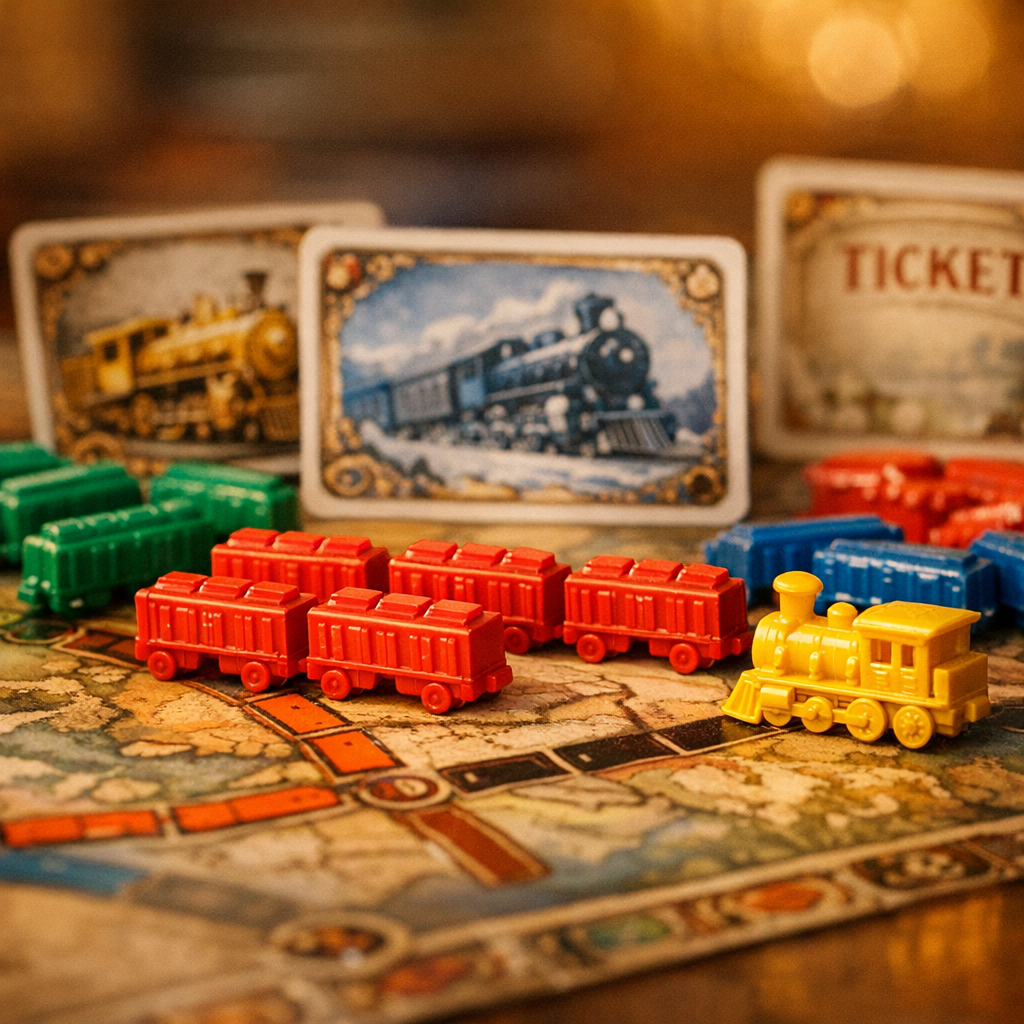
If I could only recommend one game to families just getting into board gaming, it would be Ticket to Ride. After over 200 plays with my family, it remains our most-requested game — and for good reason.
What Is Ticket to Ride?
Ticket to Ride is a train-themed board game where players collect cards and claim railway routes across a map. The goal is to connect cities listed on your secret destination tickets while scoring points for the routes you build. It's part set collection, part route planning, and all fun.
The game was designed by Alan R. Moon and published by Days of Wonder in 2004. It won the prestigious Spiel des Jahres (Game of the Year) award that same year, and two decades later, it's still one of the best-selling board games in the world.
Why Our Family Loves It
The magic of Ticket to Ride lies in its elegant simplicity. On your turn, you do one of three things: draw train cards, claim a route, or draw new destination tickets. That's it. My 8-year-old understood the rules within five minutes of our first game.
But don't let the simple rules fool you — there's real strategy here. Do you grab that long route before someone else does? Do you push your luck and draw more destination tickets? Do you block your opponent's obvious path to Miami? These decisions matter, and they create genuine tension without overwhelming complexity.
"Dad, you KNEW I needed that route! This is a betrayal!" — My 12-year-old, learning an important life lesson about competition
What I appreciate most is how the game scales with player skill. When my younger kids play, they focus on completing their tickets and collecting colorful trains. When the teenagers play, there's more blocking, more calculated risks, and more dramatic reveals at the end.
The Good Stuff
- Accessible to all ages: Rules explained in 5 minutes, meaningful play immediately
- Beautiful components: The plastic trains are satisfying to place, the board is gorgeous
- Perfect length: 45-60 minutes hits the sweet spot — substantial but not exhausting
- High replayability: Different tickets create different strategies every game
- Expandable: Many map expansions available once you're hooked
- Minimal conflict: Competition is indirect, reducing hurt feelings
The Not-So-Good Stuff
- Can feel slow with 5 players: Downtime increases, especially with analysis-prone players
- Luck of the draw: Sometimes you just can't get the colors you need
- Blocking can frustrate younger kids: When someone takes "their" route, tears may follow
- Base game only goes to 5 players: For our family of 8, we need two copies or an expansion
Which Version Should You Get?
The original Ticket to Ride (USA map) is the classic and still my recommendation for most families. It's the most balanced and widely available.
Ticket to Ride: Europe is slightly more complex with tunnels and stations, better for families with older kids or those who've mastered the original.
Ticket to Ride: First Journey is a simplified version for kids 6+. We used this to introduce our younger ones before graduating to the full game.
Tips for Your First Game
- Start with 2-3 players for your first game to keep things moving
- Don't draw extra destination tickets on your first game — focus on completing your starting ones
- Claim long routes early — they're worth more points and harder to grab later
- Keep one eye on what colors other players are collecting
- Locomotives (wild cards) are precious — save them for when you really need them
The Verdict
Ticket to Ride is as close to a perfect family game as I've found. It bridges the gap between casual and serious gamers, works across a wide age range, and creates memorable moments every time we play. Whether you're new to board games or a seasoned veteran, this one belongs on your shelf.
If your family tries it and doesn't immediately want to play again, I'll eat my conductor's hat.
Final Score: 9.5/10 — Essential for any family game collection