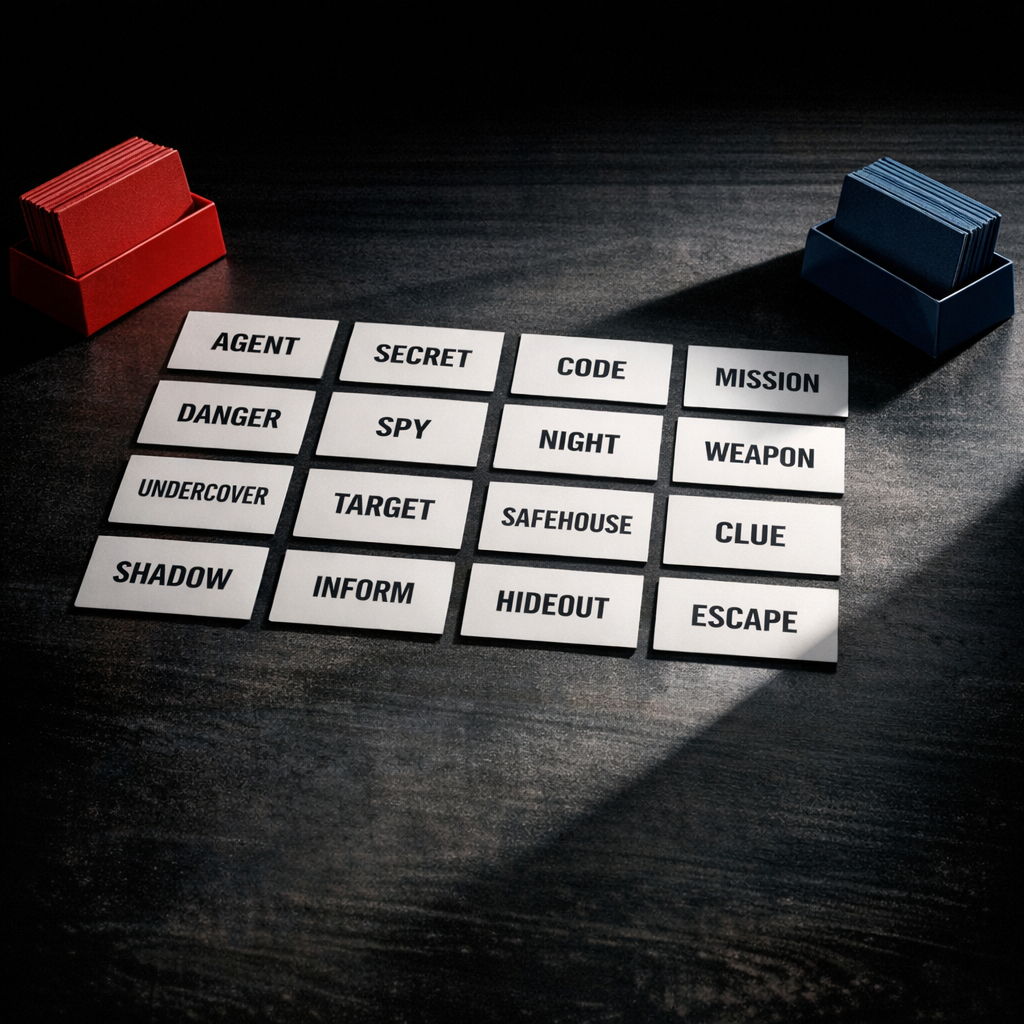
Codenames is the party game that made word association cool again. It's tense, hilarious, and creates those perfect moments where everyone erupts in laughter or groans at a terrible clue. If you host gatherings of any kind, you need this game.
What Is Codenames?
Players split into two teams, each with a "spymaster" who can see a secret key showing which words on a 5x5 grid belong to their team. The spymasters take turns giving one-word clues followed by a number, trying to get their teammates to guess their team's words without accidentally picking the opponent's words — or worse, the assassin.
For example, if your team's words include "SHIP" and "OCEAN," you might say "Water: 2" hoping they'll connect both. But what if "FISH" is on the board and belongs to the other team? Suddenly that clue is risky.
The first team to identify all their words wins. But if anyone picks the assassin word, that team loses instantly.
Why Families Love It
Codenames creates stories. Not the kind you read, but the kind you tell for years afterward. "Remember when Dad said 'FRUIT: 4' and we picked APPLE, ORANGE, LEMON, and then TEACHER because we thought he was being clever about 'apple for the teacher'? And it was the assassin?"
Yeah. We remember.
"I SAID 'ANIMAL: 3'! HOW DID YOU GET 'PIANO' FROM THAT?!" — Every spymaster at some point
The beauty of Codenames is that it's genuinely challenging for adults while remaining accessible to kids who have decent vocabularies. My 10-year-old has given clues that stumped adults and made guesses that saved the game. It's a great equalizer.
The Good Stuff
- Scales incredibly well: Works from 4 players to 10+
- Quick rounds: 15-30 minutes means you can play multiple times
- Creates memorable moments: The best and worst clues become family legends
- Simple to teach: New players understand within one round
- Cooperative within teams: Encourages discussion and teamwork
- Portable: Just cards — easy to bring to gatherings
The Not-So-Good Stuff
- Requires even teams: Odd numbers mean someone sits out or teams are unbalanced
- Vocabulary dependent: Younger kids or ESL players may struggle
- Spymaster pressure: Some people hate being the clue-giver
- Analysis paralysis: Some spymasters take forever to give clues
- Can feel repetitive: After many plays, you've seen most word combinations
Codenames Variants
The Codenames family has grown significantly:
- Codenames: Pictures — Images instead of words, great for younger kids
- Codenames: Duet — 2-player cooperative version, excellent for couples
- Codenames: Disney — Disney-themed, perfect for Disney-loving families
- Codenames: Marvel — Superhero edition
For families with younger kids (8+), I'd actually recommend starting with Codenames: Pictures. It removes the reading barrier and the images create equally fun clue-giving challenges.
- Rotate spymasters so everyone gets a turn giving clues
- Set a time limit for spymasters (2 minutes works well) to keep the game moving
- Don't be afraid to give "1" clues — they're safe and keep your team in the game
- Pay attention to what the OTHER spymaster is trying to connect
- When guessing, talk through your reasoning as a team before committing
- Embrace the chaos — the best moments come from misunderstandings
The Verdict
Codenames is the rare game that works equally well at family game night and adult parties. It's simple to learn, endlessly replayable, and consistently creates those perfect gaming moments where everyone is laughing, groaning, or shouting.
If you play games with groups of 4 or more, Codenames should be in your collection. It's earned its place as one of the most successful party games of the past decade, and in our house, it's a permanent fixture.
Final Score: 9/10 — Essential for any family that hosts gatherings