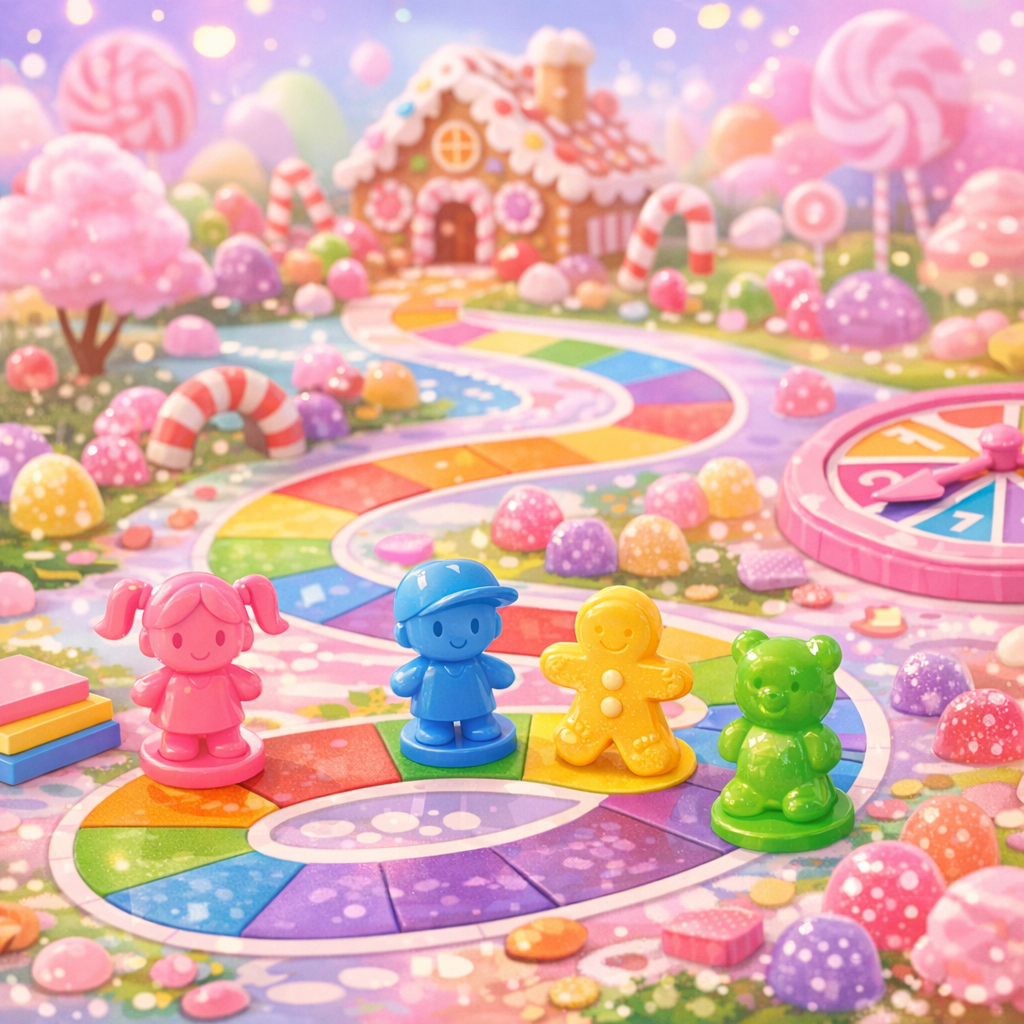
Candy Land is often a child's first board game, and for good reason. No reading required. No counting required. Just colors, a winding path, and a magical kingdom of sweets. It's not exciting for adults, but that's not the point.
What Is Candy Land?
Candy Land is a simple racing game where players draw cards showing colors and move to the next space of that color on the board. Special cards send you to specific locations — sometimes jumping ahead to Candy Castle, sometimes falling back to the Peppermint Forest. First player to reach the end wins.
That's it. There are no decisions to make. The winner is determined entirely by the shuffle of the deck. But for a 3-year-old, it's pure magic.
Why It Matters
As parents, we often evaluate games by how much fun they are for us. Candy Land will never be fun for adults. But that's missing the point entirely.
Candy Land teaches toddlers the fundamental concepts of gaming:
- Taking turns: Wait for others, then it's your turn
- Following rules: Draw a card, do what it says
- Winning and losing: Sometimes you win, sometimes you don't
- Color recognition: Match the card to the path
- Spatial reasoning: Move forward along a winding path
"I got the ice cream! I'm winning! Wait, where do I go?" — Every 3-year-old's Candy Land experience
Every one of my six kids started their gaming journey with Candy Land. It's a rite of passage in our house.
The Good Stuff
- Perfect for toddlers: No reading or counting needed
- Quick games: 15-20 minutes is perfect for short attention spans
- Colorful and engaging: Kids love the candy theme
- Teaches fundamentals: Turn-taking, rule-following, graceful losing
- Cheap and available: Found everywhere, under $15
- Nostalgic: Many parents remember playing it themselves
The Not-So-Good Stuff
- Zero decisions: Outcome is predetermined by deck order
- Boring for adults: You're just going through the motions
- Can drag: Getting sent back repeatedly extends the game painfully
- Frustration potential: Toddlers don't always handle setbacks well
- Short shelf life: Kids outgrow it quickly (usually by age 5)
Survival Tips for Parents
- Stack the deck: Remove some of the "go back" cards to shorten the game
- Add narration: Make up stories about the characters to keep yourself engaged
- Use it as teaching time: Ask about colors, count spaces together
- Play with siblings: Let older kids play with younger ones while you supervise
- Embrace the chaos: A 3-year-old's joy at winning is genuinely heartwarming
- Know it's temporary: Soon they'll be ready for better games
What Comes Next?
Once your child masters Candy Land, they're ready to graduate to games with actual decisions:
- My First Orchard (age 2+): Cooperative, introduces dice, teaches colors and counting
- Hi Ho! Cherry-O (age 3+): Simple counting and fine motor skills
- The Sneaky, Snacky Squirrel Game (age 3+): Color matching with a fun squeezy squirrel
- Hoot Owl Hoot (age 4+): First cooperative strategy game
The Verdict
Candy Land is not a good game. It's a good tool.
It teaches toddlers how games work. It creates bonding moments between parents and children. It introduces the joy of sitting around a table and playing together. These are valuable things, even if the game itself offers nothing for adults.
Buy it when your kid turns 3. Play it with enthusiasm. And then gleefully donate it when they're ready for something better. That's the Candy Land lifecycle, and it's perfectly okay.
Final Score: 6/10 — Essential for toddlers, torture for adults, and that's fine